We obtained the following setup:
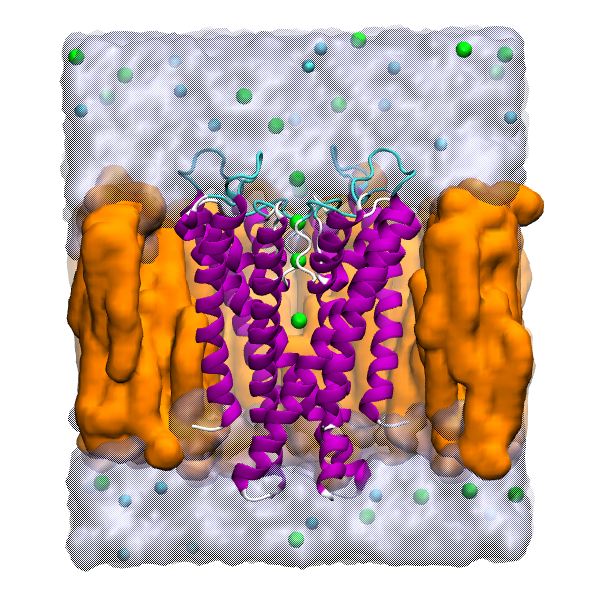
Running the simulation
We are ready to launch the simulation1.
Check each conf file individually to check that every command is properly defined
For this system, we will follow several steps.
First step
We need to equilibrate the lipidic tails with *-01.conf in NVT.
Modify the PME
Is there something you have never seen?
We should tell NAMD what to keep fixed.
Let's make sense of the errors we have.
Second step
We will restart the simulation and let everything move, but for the protein that will be harmonically restraints. The aim is to let the membrane close the gap with the protein.
We will use the tcl script keep_water_out.tcl to expel the water
molecules that flow until the system is compact enough to prevent it.
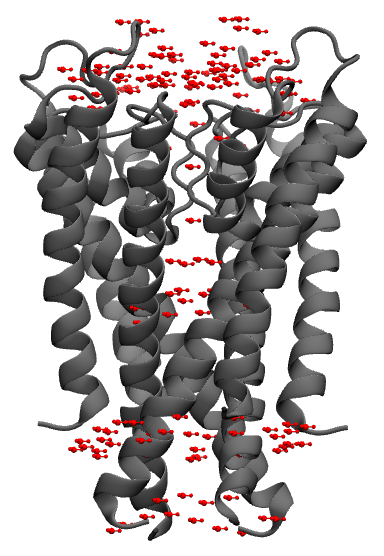 We can define exception for water molecules nearby the protein (the
WF, WCA/B/C/D).
Third step
We release also the protein to perform the equilibration.
Production
Finally, we can launch the actual simulation, keeping now constant the area of the system.
A new episode of…
MDFF
MDFF stands for Molecular Dynamics Flexible Fitting and it is a protocol to fit an atomistic structure into a density map (see the original paper ).
The need for this kind of procedure arises from the increase in the cryo-em structures, for which there is a database similar to the Protein Data Bank, the Cryo-EM database.
To achieve the wanted fitting several techniques could be employed; the rigid-body docking; the flexible fitting approach, where the macromolecule is divided into rigid pieces that are rigid-body docked and optimized with some refinement; elastic network models.
In this tutorial we will take advantage of the MD power to improve the flexible fitting that can be obtained by other software (see the reference article on MDFF).
The implementation of MDFF requires a modified potential for our simulation:
$$ U = U_{MD} + U_{CRYO-EM} + U_{SecStruct} $$
where \(U_{MD}\) is the usual ff, \(U_{SecStruct}\) preserves the secondary structure and avoid the introduction of wrong chirality, and/or cispeptide bonds. The key part is related to the \(U_{CRYO-EM}\):
\[U_{CRYO-EM}(\{\vec{r}_i\}) = \sum_j w_j V_{CRYO-EM}(\vec{r}_j)\]with \(w_j\) is a weight for each atom, and
\[V_{CRYO-EM} = \begin{cases} \xi \big[1 - \frac{\Phi(\vec{r}) - \Phi_{thr}}{\Phi_{max} - \Phi_{thr}}\big] &\quad\text{if } \Phi(\vec{r})\ge \Phi_{thr} \\ \xi &\quad\text{if } \Phi(\vec{r})\lt \Phi_{thr} \\ \end{cases}\]with \(\xi\) a scaling factor, and \(\Phi(\vec{r})\) is the data of the CRYO-EM in a given voxel. For \(\Phi_{max}\) and \(\Phi_{thr}\), look at the big screen.
For this tutorial you can download the necessary files and the instructions for the TCBG group in Urbana-Champaign.